If you've ever watched a cutter‑head river dredger working on a waterway, chewing through sediment, sand and even compacted clay like a giant aquatic lawn mower, you may wonder: how does the heavy, high‑speed rotating cutter head, mounted on a long inclined arm (known in the industry as a ladder), perform cutting work and move flexibly without damage?
The answer is the hydraulic system.
We have supplied this type of equipment for many years, and I must emphasize that the hydraulic system is not an auxiliary part. It is the core backbone of the whole cutter assembly. Below I will explain it in plain language from the job site, without obscure engineering jargon. We have seen these machines in operation on the Mississippi River, the Yangtze River and many small and medium‑sized rivers around the world.
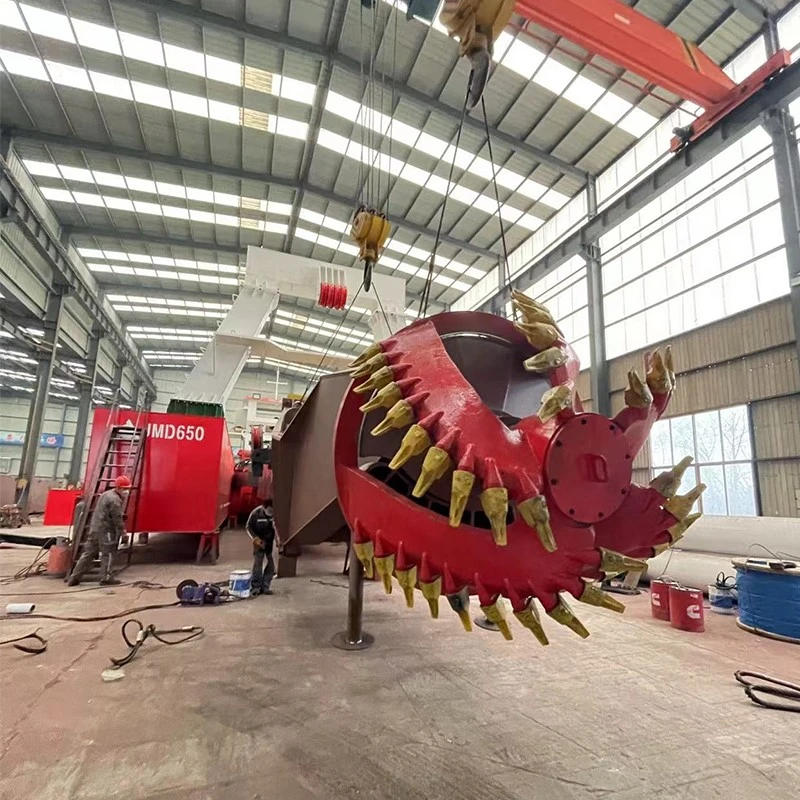
First, let's clarify what this equipment is. A river dredger with a cutter head is more than a large sand suction pump. It is precision‑built for hard materials that ordinary suction‑only dredgers cannot handle, such as hardpan on riverbeds and gravel‑mixed sand. Such materials cannot be lifted by negative pressure alone. The sharp rotating blades of the cutter head break down hard sediment into small pieces that can be sucked through the dredge pump and discharge pipeline. But the cutter head cannot spin on its own. It needs to move up, down and side to side, applying cutting pressure accurately. It must not wear itself out or bend the ladder. All of this relies on the hydraulic system.
The most obvious function of the hydraulic system is to power the cutter head. You may ask: doesn't the cutter head have a motor? Usually it is a hydraulic motor, some with electric or diesel drive. But power must be transmitted smoothly through the hydraulic system. River conditions keep changing: one moment you cut soft river sand, the next you hit compacted clay. If the cutter head ran at a fixed speed, it would stall when hitting hard layers. If it spins too fast, material will be thrown everywhere without proper breakdown. The hydraulic system adjusts the cutter torque (rotating driving force) in real time.
A few years ago we delivered a 4000 m³ sea sand cutter suction dredger. On site, the cutter head encountered a two‑foot thick hardpan layer. The hydraulic system automatically increased torque to keep cutting without shutdown. A fixed‑speed motor would have stalled immediately. Riverbed conditions are unpredictable, and this adaptability is essential.
Second, the hydraulic system drives cutter movement via hydraulic cylinders and winches. The cutter head is fitted on the ladder, which can be over 50 feet long and weigh several tons. Lowering it to the riverbed, raising it for relocation, and swinging left and right for dredging without repositioning the whole vessel requires enormous force together with high precision. Hydraulic cylinders deliver thousands of pounds of thrust with smooth adjustment; the ladder angle can be fine‑tuned by just one inch if needed.
A client on the Ohio River a few years ago worked on a levee expansion project. They needed to cut at a 15° angle to avoid buried pipelines. Our hydraulic system allowed them to adjust the ladder angle on the fly, no need to stop and disassemble heavy steel structures, saving three full days of downtime. Compared with old mechanical gear and chain drives, which are bulky and hard to adjust, hydraulic systems are widely adopted for dredging equipment today. Many inland rivers are less than 20 feet deep, much shallower than offshore dredging sites. Higher control accuracy is required to prevent the cutter head from scraping the bottom or getting stuck, and hydraulics meet this requirement perfectly.
The third core function is load and pressure protection to prevent equipment damage. As mentioned above, the cutter head cuts hard material continuously, and the ladder and hull are subjected to downward and lateral pulling forces. Our dredgers are equipped with pressure sensors to monitor cutter load in real time. If the load exceeds the limit, for example when the cutter hits a large unbreakable boulder, the system automatically reduces cutter torque, slightly adjusts the ladder angle and pulls back. This prevents motor overheating, ladder deformation and even hull tipping. It is an in‑built safety guard that reacts faster than any operator.
Many long‑term clients told us that on old dredgers without hydraulic load control, cutter heads broke or ladders bent every few months, bringing high repair costs and schedule delays. Such failures are extremely rare on our models with hydraulic protection. This is a key reason why our cutter‑head river dredgers perform reliably under tough river conditions.
Another often overlooked function is coordination with the suction and discharge system. The cutter head breaks sediment to feed the suction pipeline. The hydraulic system also helps control suction pressure. It matches the sand flow rate to the amount of material cut by the cutter head to avoid pipe blockages. Blockages are a major headache for dredging projects, especially in remote rivers where repairs are difficult. The hydraulic protection logic: when suction pressure rises too high, a signal slows the cutter head slightly to prevent pipeline overload and clogging. This is a vital link between the cutter head and the whole dredging system
With proper maintenance (we supply detailed maintenance manuals with every machine), the hydraulic system has low energy loss. Mechanical transmission wastes energy through friction between gears and chains. Hydraulics transfer power through hydraulic oil, reducing heat and wear, so fuel consumption is lower. Many clients report that after upgrading to hydraulic cutter systems, their fuel bills dropped by nearly 20% compared with old dredgers - a benefit rarely highlighted in engineering manuals.
A common question: what happens if the hydraulic system fails?
Simply put, the whole dredger stops. The cutter cannot rotate and the ladder cannot move, leaving the vessel stranded on the river waiting for repairs. Therefore our hydraulic systems are designed with redundancy: backup pumps and hoses. If one component fails, operators can switch to the backup circuit without a full shutdown. We also provide on‑site training for operators to check hydraulic pressure, spot small faults before they escalate and carry out quick emergency repairs. We deliver a complete solution, not just metal frames and cutter blades.
If you are shopping for a cutter‑head river dredger and comparing different models, please remember: the hydraulic system is not an optional extra. It is the core that enables the cutter head to work properly. No matter how good the cutter head material or blades are, without a hydraulic system capable of torque adjustment, smooth movement and overload protection, it is only a heavy metal disc sitting in the water.
We have seen many project failures: clients bought cheap dredgers with poor‑quality hydraulic systems, only to face higher repair costs and lost working time later.
If you need stable and reliable inland dredging equipment, whether for small local river works or large channel deepening projects, we can supply the full range: compact models for narrow waterways up to the 4000 m³ sea sand cutter suction dredger. Feel free to contact us for procurement discussions. We can provide specification sheets, past project case studies and help you select the right machine for your working conditions.
To sum up, the hydraulic system of a cutter‑head river dredger has three main roles:
Deliver adjustable torque to drive the cutter head, adapt to various sediments and avoid stalling;
Control the ladder and cutter movement for accurate positioning and swinging dredging;
Monitor pressure and load, protect the equipment, prevent pipe blockages and ensure continuous stable operation.